




Bill No. 1148204-8 Submitted to the State Duma to Increase Airline Liability for Baggage Delays
A bill aimed at strengthening the responsibility of airlines towards passengers for delayed baggage has been submitted to the Russian State Duma. The document proposes a significant increase in the compensation amount for each hour of delay in delivering suitcases and cargo.
Under the current version of Article 120 of the Russian Air Code, for delaying the delivery of a passenger, baggage, or cargo to its destination, the carrier pays a fine of one hundred rubles for each hour of delay.
What is changing?
According to the initiative, a change of just one word is being made to Article 120 of the Air Code: "one hundred" is replaced with "two hundred." This means the fine for each hour of baggage delay will increase from 100 to 200 rubles.
At the same time, the upper limit of the penalty remains: the total fine cannot exceed 50% of the fare, unless the carrier proves the delay was due to circumstances beyond its control (for example, a plane malfunction threatening safety, or force majeure).
Why is this needed?
The authors of the bill, a group of deputies, explain that the current compensation rate of 100 rubles per hour is long outdated and fails to serve its purpose for two reasons:
1. It does not cover real expenses. One hundred rubles per hour is often not enough for a passenger left without their luggage to purchase the most essential items: hygiene products, a change of clothes, or underwear.
2. It does not motivate airlines. A fine that is too low does not provide carriers with a serious incentive to invest in improving baggage handling systems and preventing errors.
Scale of the Problem
According to the bill's authors, the problem of baggage delays remains widespread. In 2024, more than 6 cases of baggage mishandling per thousand passengers were recorded globally. In 2025, the passenger traffic of Russian airlines exceeded 108 million people, meaning even a small percentage of errors results in hundreds of thousands of affected citizens.
When will it take effect?
The bill stipulates that if adopted, the changes will come into force immediately—from the day of the official publication of the law. According to the financial and economic justification, the implementation of this initiative will not require additional expenditures from the state budget.
According to the deputies, if the law is passed, passengers can count on fairer compensation for a vacation or business trip spoiled by delayed baggage, and airlines will have an additional incentive to improve their service quality. However, we believe that increasing the fine by 100 rubles is unlikely to drastically change the situation in the current climate.
Comparison with Airline Liability on International Flights
Furthermore, this fine applies only to domestic Russian flights. Liability on international flights is governed by the Montreal Convention of 1999 for the Unification of Certain Rules for International Carriage by Air, where the compensation limits are significantly higher.
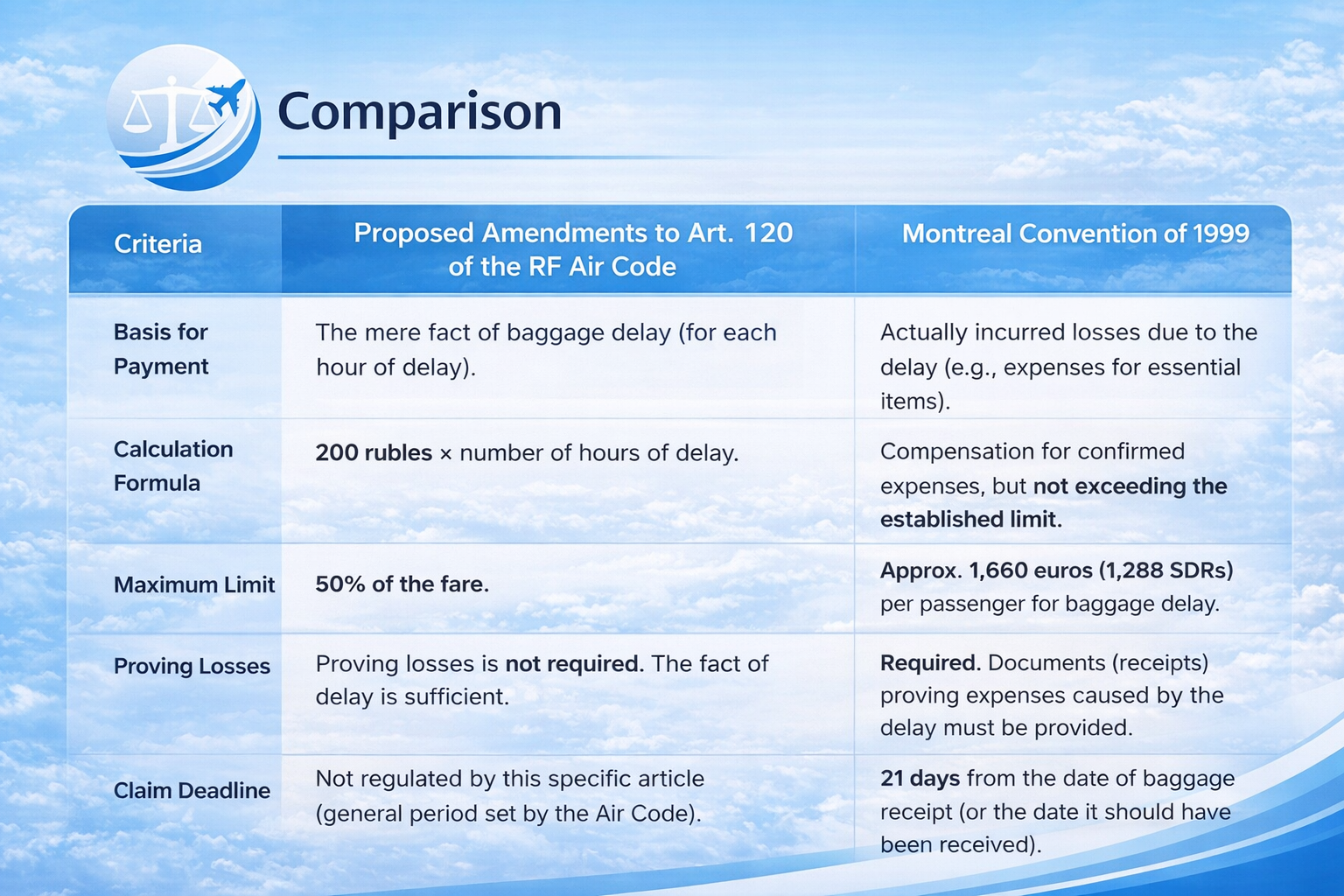
Here is a comparison of the liability for baggage delay under the proposed amendments and the Montreal Convention:
A bill aimed at strengthening the responsibility of airlines towards passengers for delayed baggage has been submitted to the Russian State Duma. The document proposes a significant increase in the compensation amount for each hour of delay in delivering suitcases and cargo.
Under the current version of Article 120 of the Russian Air Code, for delaying the delivery of a passenger, baggage, or cargo to its destination, the carrier pays a fine of one hundred rubles for each hour of delay.
What is changing?
According to the initiative, a change of just one word is being made to Article 120 of the Air Code: "one hundred" is replaced with "two hundred." This means the fine for each hour of baggage delay will increase from 100 to 200 rubles.
At the same time, the upper limit of the penalty remains: the total fine cannot exceed 50% of the fare, unless the carrier proves the delay was due to circumstances beyond its control (for example, a plane malfunction threatening safety, or force majeure).
Why is this needed?
The authors of the bill, a group of deputies, explain that the current compensation rate of 100 rubles per hour is long outdated and fails to serve its purpose for two reasons:
1. It does not cover real expenses. One hundred rubles per hour is often not enough for a passenger left without their luggage to purchase the most essential items: hygiene products, a change of clothes, or underwear.
2. It does not motivate airlines. A fine that is too low does not provide carriers with a serious incentive to invest in improving baggage handling systems and preventing errors.
Scale of the Problem
According to the bill's authors, the problem of baggage delays remains widespread. In 2024, more than 6 cases of baggage mishandling per thousand passengers were recorded globally. In 2025, the passenger traffic of Russian airlines exceeded 108 million people, meaning even a small percentage of errors results in hundreds of thousands of affected citizens.
When will it take effect?
The bill stipulates that if adopted, the changes will come into force immediately—from the day of the official publication of the law. According to the financial and economic justification, the implementation of this initiative will not require additional expenditures from the state budget.
According to the deputies, if the law is passed, passengers can count on fairer compensation for a vacation or business trip spoiled by delayed baggage, and airlines will have an additional incentive to improve their service quality. However, we believe that increasing the fine by 100 rubles is unlikely to drastically change the situation in the current climate.
Comparison with Airline Liability on International Flights
Furthermore, this fine applies only to domestic Russian flights. Liability on international flights is governed by the Montreal Convention of 1999 for the Unification of Certain Rules for International Carriage by Air, where the compensation limits are significantly higher.
Here is a comparison of the liability for baggage delay under the proposed amendments and the Montreal Convention:
The airline is exempt from paying the fine if it proves the delay occurred due to:
Force majeure (natural disasters, military actions, terrorist acts, etc.).
Rectifying an aircraft malfunction that threatened the life or health of passengers (i.e., if the plane broke down in a way critical to safety).
Other circumstances beyond the carrier's control.
Force majeure (natural disasters, military actions, terrorist acts, etc.).
Rectifying an aircraft malfunction that threatened the life or health of passengers (i.e., if the plane broke down in a way critical to safety).
Other circumstances beyond the carrier's control.


